Tip #7- Hues of Blue: Blue is a soothing color and a symbol of commitment. It is a constant in our lives, from the color of the sky to the color of the ocean.

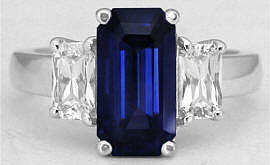
1.50 ctw Princess Cut Blue Sapphire and Diamond Ring in 14k

1.50 ctw Princess Cut Blue Sapphire and Diamond Ring from MyJewelrySource

Sapphires are the best choice for many reasons (including their superior hardness and range of colors) for a blue gemstone engagement ring. Other options include tanzanite, which also had purple tones, and aquamarine, a lighter, softer shade of blue, has been the focal point of many outstanding engagement rings we have created. If she likes sky blue or turquoise blue, don’t overlook blue topaz engagement rings and blue zircon engagement rings.

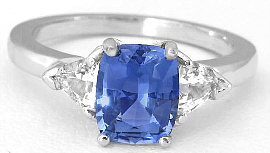
2.30 ctw Blue Zircon and Diamond Ring in 14k white gold

2.30 ctw Blue Zircon and Diamond Ring from MyJewelrySource

Did you know that blue zircon is one of the most sparkly gemstones? With a refractive index similar to that of a diamond, it is a brilliant beautiful stone.  Blue zircon and Swiss blue topaz often look very similar. The highest quality of blue zircon has a color saturation that blue topaz does not have. Both are reminiscent of a gorgeous bright blue sky, or of the Caribbean sea.

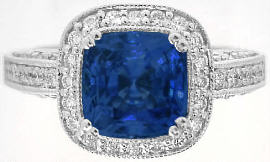
Sapphires too can be very sparkly; this is particularly true of sapphires with Ceylon origin. At MyJewelrySource, we primarily offer Ceylon sapphire engagement rings for that very reason. Ceylon sapphires are found in a wide range of blue shades from periwinkle to cornflower to cobalt and royal blue. Sapphires from other locations like Africa or Thailand are also quite beautiful and generally have a richer, darker tone.

3.05 ctw Pear Shape Tanzanite and Diamond Ring in 14k

3.05 ctw Pear Shape Tanzanite Ring from MyJewelrySource

Tanzanite is found in only one location in the world, Tanzania, Africa. It is an exceptional bluish purple gemstone and is often found in large sizes. Lower quality material often is more of a lavender color, which is actually quite pretty. The lighter colors are more affordable and often times set in silver rather than precious gold or platinum.

Affordability: 

Blue topaz is the most affordable of the blue gemstones with blue zircon following as a close second. Fine quality aquamarine, particularly the prized Santa Maria aquamarine, is very rare and is priced accordingly. Some qualities and colors of blue sapphire are very affordable especially in sizes of 1 carat or smaller. Fine, vivid cornflower blue Ceylon sapphires are among the most expensive, which reflects the rarity and the quality of the gem.

2.55 ctw Round Aquamarine and Diamond Ring in 14k

Example of Aquamarine Engagement Ring Set from MyJewelrySource

Share
, , ,

Tip #6- Green with Envy: There are so many options if she is drawn to green. You can choose from emerald, peridot, green amethyst, green tourmaline, seafoam tourmaline, tsavorite garnet, and green sapphire. The choices for green can seem overwhelming but these green gemstones are all very distinct in their look.

Emerald Engagment Ring

Emerald Engagment Ring from MyJewelrySource

Emeralds are the color of a beautiful lawn, a rich yet bright green. Emeralds are one of the rarest gemstones and do command a premium in price. They are also commonly with found with natural birthmarks, or inclusions, in the gemstones. Emeralds are one of the only gemstones in which it is not only common but quite acceptable to be found with inclusions. Too many inclusions can cause the stone to look unattractive and dull, but few inclusions are just fine and the rich color of the stone often masks these birthmarks. The birthmarks are unique evidence that the gemstones were created naturally, deep inside the Earth. Emeralds are generally found in smaller sizes and stones over 1 carat are considered rare. MyJewelrySouce.com has a small but very fine collection of emerald engagement rings.

Peridot is more of an apple green, a bright and lively stone. Peridot is relatively inexpensive and is easily found in sizes up to 5 carats. Peridot rings are just a pleasure to wear. The color is vibrant and in a certain sense, cheerful.

Green Amethyst Ring (Prasiolite)

Green Amethyst Ring (Prasiolite) from MyJewelrySource

Green amethyst can be considered more of a neutral since it has a very soft celadon green color. Since green amethyst is readily available in sizes from 1 carat to 20 carats, they are many ring options available. Green amethysts are very inexpensive and you can really get a lot of bang for your buck, so to speak, with green amethyst.

Seafoam Green Tourmaline Ring

Seafoam Green Tourmaline Ring from MyJewelrySource

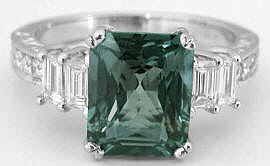
A green tourmaline engagement ring might be one you would choose to match her eye color. Green tourmaline can be a forest green or olive green, generally saturated in color. We have a small, carefully chosen selection of green tourmaline engagement rings. Many of the styles even have matching bands. Seafoam tourmaline is one of our favorites at MyJewelrySource because it has a wonderful unique combination of turquoise, mint, and apple green all in one incredible stone.

Share
, , ,
1.66 ctw Yellow Sapphire and Diamond Ring in 14k

A classic engagement style with a twist- a light yellow sapphire center stone.


Tip #5- Mellow Yellow: If yellow is her favorite color, consider yellow sapphire or pale citrine. Yellow sapphire is available in many shades of yellow from banana to lemon to butter to sunshine yellow. Citrine can be a soft and delicate golden yellow but it can also be more of an intense yellow orange. Yellow is a neutral color that will look great on many skin tones. The yellow gemstones often are more striking in a white metal because there is a subtle contrast between the yellow and the white. When yellow gemstones are set in yellow gold, the beautiful color of the gemstone becomes less noticeable because it is competing with the yellow metal. Yellow sapphires are commonly found in sizes up to 2 carats, but fine stones in sizes over that are quite rare. And if you love the look of yellow diamonds, yellow sapphire rings are a fabulous engagement ring alternative.

1.75 ctw Yellow Sapphire Ring in 14k white gold

A beautiful yellow sapphire engagement set for those looking for a non-diamond engagement ring set.

Share
, ,


1.11 ctw Orange Sapphire and Diamond Ring in 14k

Example of an princess-cut orange sapphire engagement ring set.

Tip #4- Orange Delight: Citrine, orange sapphire, and spessartite garnet are gemstones that are available in shades of orange. Madeira citrine and deep golden citrine are warm and inviting. Orange sapphires can be the color of an orange peel, a bright, cheerful and eye catching color or they can be found with hints of yellow for more of a yellow-orange or golden orange color. Fine spessartite garnet also has the vibrant color of an orange peel. It is also found with shades of brown and red.

Citrine Engagement Ring Set

An example of a Citrine Engagement Ring Set.

Share
, , ,


Rubellite Tourmaline Engagement Ring

Example of Rubellite Tourmaline Engagement Ring. Tourmaline is the alternate October birthstone.

Tip #3- Radiant Red: If she loves red, consider garnet, rhodolite garnet, ruby or rubellite tourmaline. Red gemstones look great in white and yellow metals. The yellow metals are warm and complement the red gemstone and the white metals are a striking contrast with the red gemstone. Garnets are generally more of a burgundy while rhodolite garnets have a hint of pink. Rubies can be cherry red, blood red, or have hints of purple or pink. Rubellite tourmaline, one of the prettiest, most striking gemstones, is generally a deep vivid reddish magenta but can also be found as a hot pink or a reddish pink. Rubies are the most expensive of the red gemstones, sometimes commanding prices of up to $30,000 per carat for the very finest material.  Don’t despair, while more expensive than the other red gemstones, a beautiful ruby engagement ring still be found at a much more affortable price. Garnets and rhodolite garnets are very affordable and are readily available in many shapes and siess.

Ruby Engagement Ring

Example of a Burmese Ruby and Trapezoid Diamond Engagement Ring. The fiery color of this ruby symbolizes devotion, passion, desire, and luxurious opulence. Ruby is the birthstone for July.

Share
, , , ,


Aquamarine Engagement Ring

An example of an aquamarine engagement ring set. Aquamarine is the birthstone for march and symbolizes happiness and everlasting youth.

Tip #2- Choosing the Perfect Color:  Gemstones come in every color of the rainbow and as mentioned in Tip #1, there are many ways to choose a color that you would like as a gemstone engagement ring such as birthstones, etc.  As a general guideline, if she wants a soft subtle color, try aquamarine, green amethyst, citrine, yellow sapphire or light pink sapphire. For a bold, primary color look, try blue sapphire, ruby or emerald. Jewel tones would include amethyst, ruby, blue sapphire, green tourmaline and orange sapphire.

Share
, ,
Blue Zircon and Diamond Ring

A Blue Zircon and Diamond Gemstone Engagement Ring. Blue Zircon is the birstone for December. Since zircon has a high refractive index, its sparkle is similar to that of a fine diamond.

Tip #1-Think outside the box. You already are, in fact, if you’re considering a gemstone engagement ring. Diamonds are beautiful and rare, but it’s so much more eye-catching and unique to wear a gemstone engagement ring. There are many approaches that you can use to select the perfect gemstone. You could choose her birthstone or your birthstone. Or you could find a gemstone engagement ring that incorporates both birthstones. At MyJewelrySource, we make most of our jewelry in house so if you would like to incorporate two gemstones in one of the rings you see on our website, we can definitely do that for you. How about a blue or green gemstone that matches her beautiful eye color. You can also choose the gemstone of the month you’re getting married or even of the month you first met. Or simply choose her favorite color! Gemstones are available in just about every color so you will have a lot of engagement ring options no matter what choice you make.

Share
, ,
Rubellite Tourmaline

Rubellite Tourmaline from MyJewelrySource.com

One of the world’s renowned mining areas is the state of Minas Gerais in Brazil. The location produces some of the finest tourmalines, aquamarine, morganite, chrysoberyl, and emerald, just to name a few. Mining is a very risky and difficult task as it is always a gamble as to whether or not exceptional gem deposits will be found. One amazing story involves the Jonas mine located in Minas Gerais. In 1978, the mine was thought to contain large deposits of rubellite tourmaline, but after 6 months of digging with absolutely no good results, the miners only had financing for one final week of digging. One of the miners had a premonition of a huge gem pocket which encouraged the miners not to give up and to keep digging.  As luck would have it, they found a truly magnificent pocket that once excavated was 8 by 10 feet in size. It had almost 450 pounds of spectacular rubellite tourmaline crystals. One crystal was large enough to yield a million dollars worth of cut gems. A smaller second pocket was also found but it was not as spectacular as the first. Although mining at this location was essentially exhausted after a couple weeks of excavating, the miners hard work sure proved to be worth it.

It is interesting to think about all the things what could have happened to cause the difference between a 100% loss of their investment and their big payoff.  The pocket containing the crystals was on 8 by 10 feet.  Imagine how easy that would have been to miss.  Imagine how many gem containing pockets have been missed by other miners in the past and how many must be out there.

Share
, , ,

Did you know that the natural pearl industry in the late 1800′s was actually a by-product of the button industry? Read more about it here…

Today, nearly all pearls, whether they are Akoya, freshwater, Tahitian or South Sea, are cultured, meaning that a pearl formed as a result of human intervention. Prior to pearl culturing, which began around 1900, pearls were completely natural. They were formed by the mollusks on their own as a result of an irritant getting inside their shell. The farming of natural pearls was not a business in and of itself because divers would sometimes have to recover hundreds and hundreds of mollusks just to find one pearl. It just wasn’t cost effective.

9.7 mm Cultured Tahitian Pearl & Diamond Ring

9.7 mm Cultured Tahitian Pearl & Diamond Ring from MyJewelrySource

The natural pearl business was actually a by-product of the button business. Buttons were once made from natural mother of pearl, the nacreous layer inside the shell of a mollusk. Whenever the mollusks were harvested and a natural pearl was present, it was set aside. Natural pearls were a symbol of status and wealth and were highly coveted. By the 1920′s, the button business had transformed and buttons were being manufactured in mass quantities from plastic. This caused a huge decline in the natural pearl market since the mollusks were no longer being harvested. Today, it is too costly to dive for natural pearls and the business isn’t really viable. So natural pearls are very very rare.  Today almost all pearls in pearl jewelry are cultured pearls.  This includes all pearls sold at MyJewelrySource.

Share
,
Myanmar (Burmese) Ruby

Myanmar (Burmese) Ruby set with trapezoid diamonds in white gold

Myanmar (formerly known as Burma) is known for its exceptional rubies. It is not widely know that Myanmar also produces very fine quality sapphires.

Sapphires from this country command very high prices for the top quality gemstones with intense or vivid saturation with rich royal blue color. The best sapphires maintain their exceptional color under all lighting conditions, incandescent, daylight and fluorescent, something you rarely see in sapphires. These sapphires do not have the velvety appearance that Kashmir sapphires are known for. Just as with any origin, not all sapphires from Myanmar are so outstanding. Some sapphires are dark or even very light in color.

Fine Burmese Sapphire (from Myanmar)

Fine Burmese Sapphire (from Myanmar)

Rubies and sapphires have been mined in Myanmar for about 800 years. Sapphires are about 10 percent of the output. Mining has been sporadic over the years due to the remote location. Even today, political and economic troubles limit mining activities. Mining is done by government-run and private businesses using both mechanized and primitive techniques. Once the rough is mined, it often heads for Thailand, where the majority of sapphire and ruby fashioning (treating and cutting) is done. Some gems leave Myanmar through unauthorized channels and smuggling is common.

Most Burmese sapphires are heat treated to remove or reduce the silk inclusions. Heat treatment improves the luster and clarity and it can also lighten the darker stones. Because of their origin, fine Burmese sapphires do command higher prices than sapphires of other origins like Madagascar or Montana, but identifying the origin can be difficult if not impossible. Origin identification is most often possible through the identification of that origin’s characteristic inclusions. But since inclusions can be significantly altered by heat treatment, identification can become impossible after heat treatment has been performed.

Share
, , , , ,